Sound familiar?Orangeville
- The call
- You heard a sharp bang from the garage, and now the opener hums for a second and gives up. The door lifts a few centimetres at most, then settles back down as if something very heavy is holding it in place.
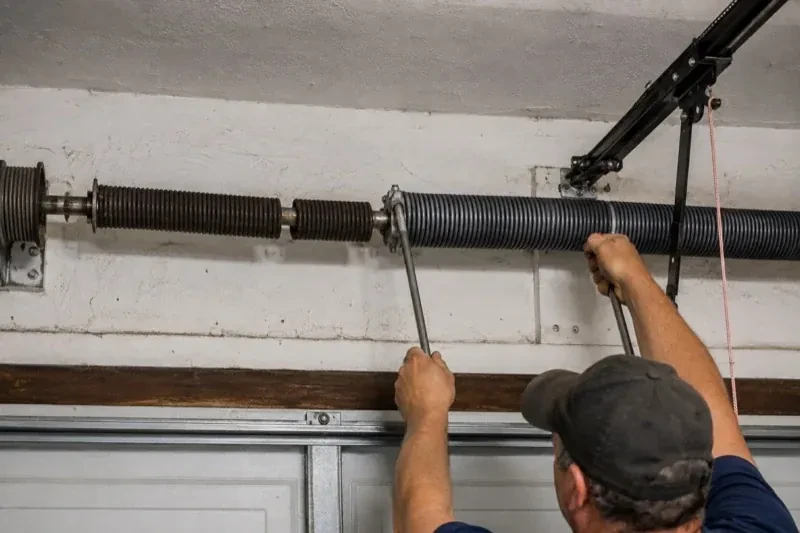
The finished result is a door that behaves the way a good garage door should: it lifts by hand with light effort, stays where you leave it at mid-height, closes softly and lets the opener run with little strain. Reaching that point involves measuring the door, choosing a matched spring, winding it to the correct turns and testing the balance through the full travel. The technician then runs the opener's reversal test and lubricates the moving parts. You are left with a record of the spring installed, so future service starts from known specifications.
Sound familiar?Orangeville
Torsion Spring Replacement · Orangeville
Scene 1
A torsion spring pushes against a centre bracket bolted to the header above the door, and that anchor takes the full reaction force every cycle. The technician checks that the bracket is fastened into solid framing with proper lag bolts, that the header wood has not split or softened with moisture, and that the end bearing plates on each side are square and tight to the jamb. Loose or corroded fasteners are noted for replacement. A sound anchor keeps the shaft level and the spring pulling straight, which protects both the new spring and the bearings that carry it.
Scene 2
Once the clamps are off, the technician lifts the door by hand to about waist height and lets go. A balanced door stays where it is, or drifts only slightly. If it rises on its own, the spring has a little too much tension and is eased a quarter turn; if it drops, a quarter turn is added. The door is then run through its full travel, watching that both sides move together and the sections stay flat in the tracks. This is repeated until the door feels light and stops cleanly at several heights, which is the standard the whole job is measured against.
Scene 3
Your opener benefits as much as the door. With the spring carrying the weight again, the motor, gear drive, trolley and rail return to the light duty they were designed for, which tends to mean a longer working life and less noise. Force settings have been reset to suit a balanced door, so the safety reversal reacts to a genuine obstruction rather than to a heavy door. Once a year, repeat the simple reversal test by placing a length of wood flat on the floor in the door's path and confirming the door reverses on contact. The opener's photo-eye sensors deserve a wipe at the same time.
What shapes the quoteHockley Valley Garage Door Experts
FeesSame any hour
Watch for a door that feels heavier by hand when the opener is released, an opener that strains or slows, a door that drops the last stretch rather than settling, or one that drifts down when stopped halfway. Visually, look for stretched gaps between coils, rust streaks or pitting on the steel, and any sag in the shaft. A balance check when you notice these lets you plan a replacement rather than react to one.
The shaft is free during a spring change, which makes it the natural time to renew the centre bearing and end bearings if they grind or wobble. Lift cables that show fraying or rust at the bottom brackets are replaced so the new spring pulls on sound steel, and cracked or worn drums are swapped. On older doors, a corroded centre bracket or loose lag bolts may also be addressed. Each item is shown and explained before it is added.
The centre bracket anchors the spring's reaction force to the framing above the door, so it has to be solid. If the header has split or softened, or the lag bolts have pulled, the technician can refasten into sound wood, add a reinforcing plate or replace the bracket before the new spring is wound. Dealing with this first keeps the shaft level and the spring pulling straight, which protects the bearings and the door.
DufferinOntario
Torsion Spring Replacement · Amaranth, East Garafraxa, Grand Valley, Melancthon, Mono, Shelburne, Southgate, Starrview Acres
Every square is one home in a hundred.
On-site assessment
The door starts to rise, gets about the height of your knee, then shudders and reverses.
(226) 917-2730, open 24/7.
On-site assessment preferred · (226) 917-2730, open 24/7